When Does Refinancing Make Sense? Compare Rates, Costs, and Your Break-Even Point


When does refinancing make sense? Compare rates, costs, and your break-even point before you focus on a smaller monthly payment. The right mortgage refinance should support your goals and pay for itself on a timeline that works for you.
Key Takeaways
| Question | Quick answer |
|---|---|
| What is the break-even point? | Divide the refinance costs by the monthly savings you can actually count on. The result is the number of months you need to keep the new loan to recover those costs. |
| Which monthly payment should I compare? | Compare principal and interest when taxes and insurance will not change. Separate any changes to taxes, insurance, or mortgage insurance. |
| Does a lower payment mean I save money? | No. A longer loan term can lower the payment while increasing total interest and leaving you with a higher loan balance later. |
| Which costs belong in the calculation? | Include lender and third-party fees, plus any discount points. Separate prepaid interest and escrow funding from actual refinance fees. |
| What if I might move or refinance again? | Compare your expected time with the break-even timeline. If you may end the new loan before you recover its costs, the refinance may not win. |
| Where can I see the basic calculation? | Our refinance break-even guide walks through the math and reasons to refinance. |
Start with the break-even point, not the headline rate
The break-even point is how long it takes your monthly savings to repay the costs of refinancing. Divide your refinance costs by your monthly savings to estimate how many months it takes.
If you expect to keep the new loan beyond that point, you have time to recover the upfront costs.
That estimate is a starting line, not the finish. It works best when the old and new loans have comparable terms and the monthly savings reflect the payment difference caused by the refinance.
When does refinancing make sense if you may move, sell, or refinance again? Compare the break-even point with the date you expect to end the loan, then leave room for uncertainty. A refinance that only works if everything goes exactly to plan is a fragile win.
In 2026, compare actual loan offers and your own plans, not a rate headline or a rule of thumb. A perfect rate you never lock is worth nothing, but a lower rate that cannot earn back its costs may not help you either.
Compare refinance rates and calculate real monthly savings
Compare the new rate with your current rate, but look at the full loan offer too. Check the annual percentage rate, discount points, loan term, lender fees, and projected principal-and-interest payment.
Mortgage rates aren't set by one person in a back room. The Fed doesn't set your mortgage rate directly, but its policy rate and its tone about inflation move the bond market, and mortgage rates follow the bond market.
Ask for Loan Estimates that use the same loan amount, term, and points so you can make an honest comparison. You can request a free mortgage refinance consultation to review your options and put the numbers in context.


For a break-even calculation, compare principal and interest if property taxes and homeowners insurance stay the same. Those costs can change for separate reasons, so counting an unchanged tax or insurance amount as refinance savings can make the new loan look better than it is.
Use the full housing payment to plan your monthly budget, but keep the refinance savings calculation focused on costs that actually change. If mortgage insurance will end or a tax bill will shift, list that change separately so you can see what is driving the difference.
Source: Bankrate
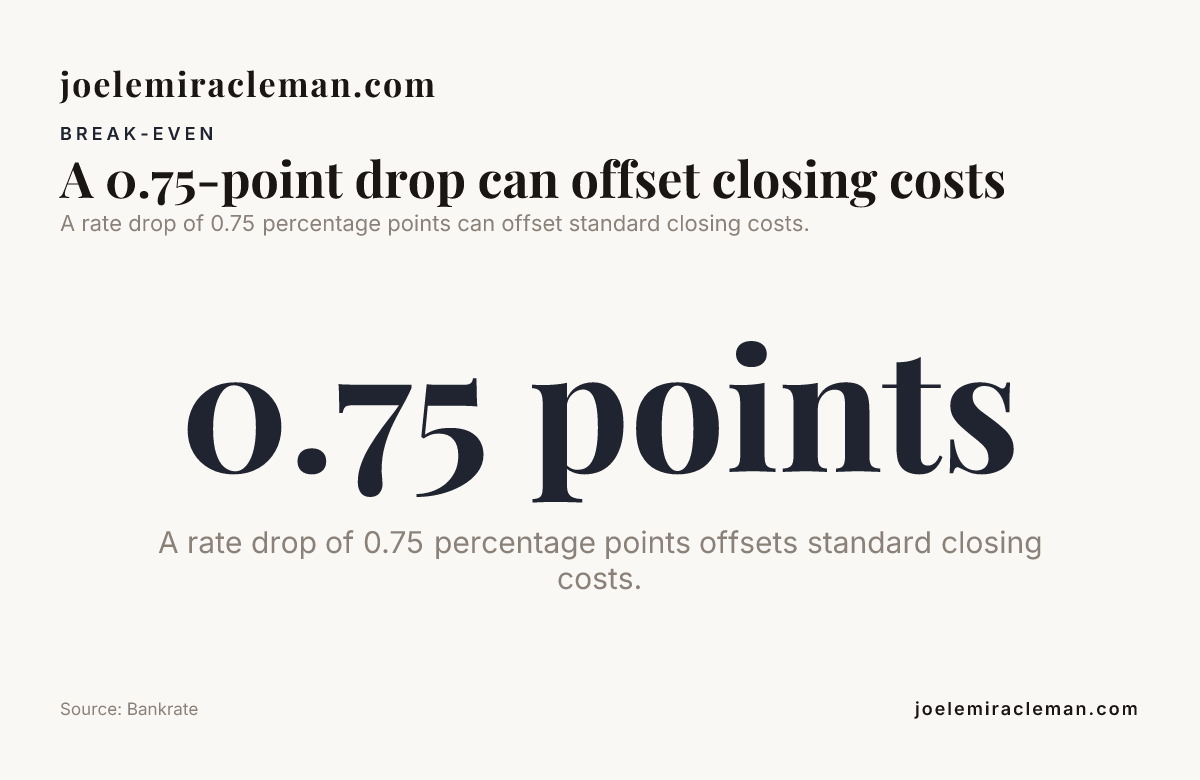
Treat a rate-drop claim as a prompt to run the math, not a guarantee that costs are covered. A lower rate offsets closing costs only when the monthly principal-and-interest savings, accumulated for the time you expect to keep the loan, exceed the fees. The result also depends on the loan balance, term, points, and other costs, so compare matched offers and use your own Loan Estimates.
Did You Know?
It is not unusual to pay 3 percent to 6 percent of your outstanding principal in refinancing fees.
Source: Federal Reserve Board
The Federal Reserve Board figure is a broad estimate, not a quote for an individual refinance. Your actual costs depend on the loan and transaction, so use the itemized charges in your Loan Estimate rather than applying that percentage to your balance.
Count refinance costs carefully
Include lender charges, such as origination or underwriting fees, and third-party charges, such as appraisal, title, credit, and recording fees. Add discount points if you pay them to get a lower rate.
Then separate actual fees from amounts that are due at closing for other reasons. Prepaid interest covers interest due before your first regular payment, while escrow deposits fund future property tax and insurance bills.
Those prepaid amounts can affect how much cash you need on closing day, but they are not automatically the same as a fee charged to refinance. Compare each Loan Estimate line by line, and distinguish loan costs from prepaid items and escrow funding before using a total in your break-even math.
Also consider what your upfront cash could do elsewhere. If paying the costs out of pocket would drain an emergency fund or delay a higher-priority expense, include that trade-off in your decision.
A rate-drop shortcut can be tempting, but it is not a reliable decision by itself because your loan balance, fees, term, and time in the home all affect the result.
Compare the loan term, total interest, and future balance
A lower monthly payment does not prove that refinancing saves money overall. If you replace the years left on your current loan with a fresh, longer loan term, the payment may drop even as you pay interest for longer.
Compare both loans at the same future date. Look at your total payments, total interest, and remaining loan balance under each option, not just the monthly payment.
- Monthly payment: How much cash leaves your budget each month?
- Total interest: How much interest will you pay over the period you expect to keep the loan?
- Loan balance: How much principal will you still owe at the same future date?
This comparison matters when you shorten the loan term, too. A shorter term can raise your monthly payment while helping you pay principal faster and reduce the time you carry the debt.
When does refinancing make sense if your payment stays the same or goes up? It can still fit if you are moving to a shorter term, removing mortgage insurance, or changing from an adjustable-rate mortgage to a fixed-rate mortgage for more predictable payments. Set a clear goal, then compare the cost of reaching it with keeping your current loan.
Evaluate cash-out refinancing and loan-type changes
A cash-out refinance replaces your current mortgage with a larger loan and gives you part of the difference in cash. That may support a planned expense, but the proceeds are borrowed money secured by your home, not savings.
Compare the cash-out refinance with the alternatives you would actually use. Review the new loan balance, rate, fees, monthly payment, total interest, and payoff timeline, then weigh those against other ways to handle the expense.
Debt consolidation deserves the same careful math. Moving credit-card or other debt into a mortgage can change the payment structure, but it also puts that debt against your home and may stretch repayment over a longer period.
Switching between an adjustable-rate mortgage and a fixed-rate mortgage can also serve a goal beyond a lower payment. Compare the new loan's costs and terms with the risk or payment changes you want to manage, rather than treating the rate alone as the whole answer.
Compare upfront costs, rolled-in costs, and no-closing-cost offers
Rolling closing costs into the new loan reduces the cash you need at closing, but it increases your loan balance. You may pay interest on those costs for the life of the loan, and the higher balance can change how much principal you owe later.
A no-closing-cost refinance does not make the costs disappear. The lender may cover them in exchange for a higher rate, or the charges may be built into the loan in another way.
Compare both options over the time you expect to keep the mortgage. Put the rate, payment, loan balance, and total costs side by side, and include any cash you would otherwise pay upfront.
At what point does refinancing stop making sense? It is a poor fit when the expected savings do not recover the costs before you sell, refinance again, or otherwise end the loan, and when the new terms undermine your larger goal.
Frequently Asked Questions
What does Dave Ramsey say about refinancing mortgages?
For your own mortgage refinance, compare the payoff timeline and total cost with your financial goals.
Dave Ramsey generally favors fixed-rate mortgages and paying a home off quickly, and cautions against cash-out refinancing that turns home equity into spending money. In that approach, refinancing should help reduce costs or accelerate payoff, not simply reset the loan to a longer term for a lower payment. Compare total interest and payoff timing as well as the monthly payment.
Can I refinance if my home value has fallen?
Possibly, but your equity and the new loan's loan-to-value ratio can affect your options and terms. Ask a lender to review your current value, mortgage balance, and refinance goal together.
Does refinancing hurt your credit score?
A lender may check your credit as part of the application, and a new mortgage account can affect your credit history. Before applying, ask how the lender handles credit checks when you are comparing refinance offers.
How soon can I refinance after buying a home?
There is no single waiting period that applies to every mortgage refinance. Lender rules and the type of loan or refinance can affect when you qualify, so ask about timing before you count on a quick refinance.
How much equity do I need to refinance my home?
The amount depends on the refinance type, lender requirements, and whether you want cash out. Your equity can also affect the available loan terms, so include the estimated home value and current loan balance when you ask for options.
Do I need an appraisal to refinance?
Some refinances require an appraisal to establish the home's value, while other applications may qualify for an appraisal waiver. The lender can tell you which valuation method applies to the loan you are considering.
What is the traditional rate-drop rule for refinancing?
It is a rule of thumb that says to refinance only after the new rate falls by a preset margin. That is not a hard requirement: a smaller drop may still work when fees are low and you keep the loan long enough, while a larger drop may not pay off if costs are high or you leave soon. Compare actual offers and use your break-even point instead of relying on the shortcut.
Conclusion
When Does Refinancing Make Sense? Compare Rates, Costs, and Your Break-Even Point by looking beyond the headline rate and monthly payment. Count the true costs, compare the loans over the same timeline, and make sure your expected savings or other goal justifies the new terms.
Refinancing resets your loan and costs money up front, so the only question that matters is: will the savings pay back the cost before you move or refi again? Run the numbers honestly, and you can choose the loan that helps you win over the long run.
Ready to run your break-even numbers with a loan officer who closes the loans?
Start Your Refi